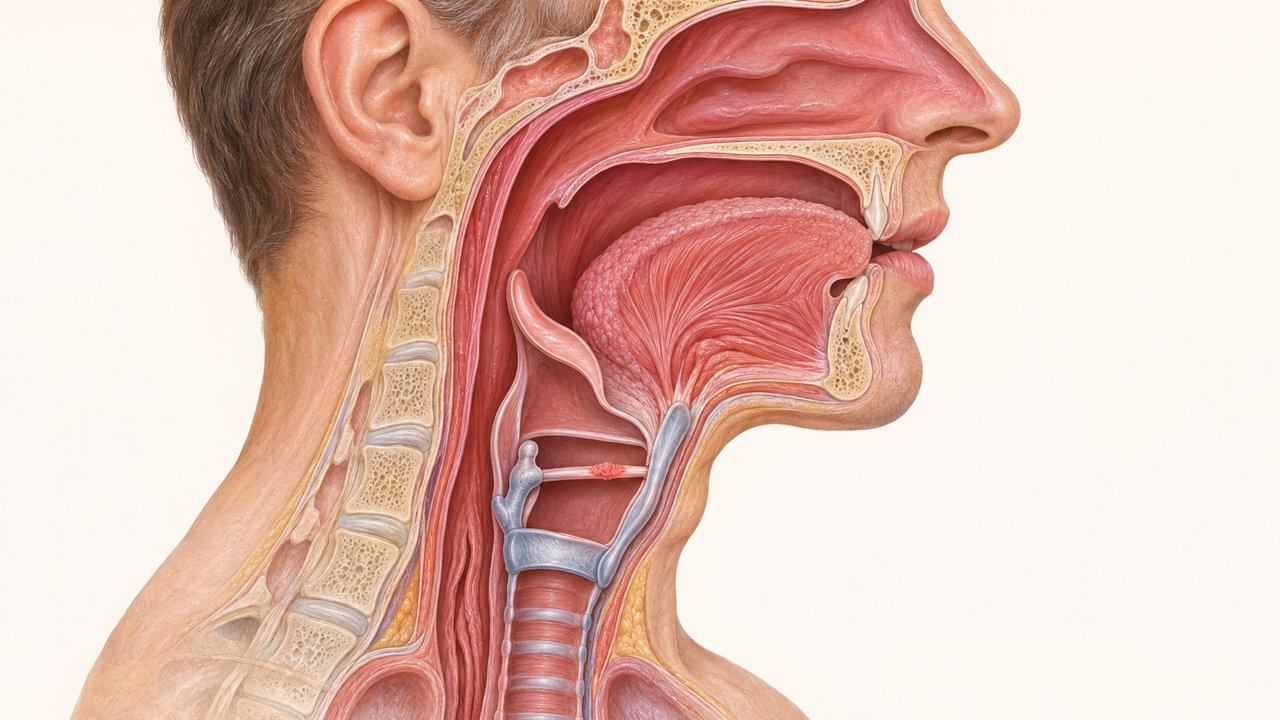
Laryngeal cancer (cancer of the voice box) is a disease in which malignant (cancer) cells form in the tissues of the larynx.
The larynx is the part of the throat between the base of the tongue and the windpipe. It contains the vocal folds, which vibrate as air passes over them to produce sound. The sound resonates in the pharynx, mouth and nose to become a person’s individual voice.
The larynx has three main parts:
- Supraglottis: The upper part of the larynx, above the vocal folds; it includes the epiglottis.
- Glottis: The middle part of the larynx, containing the vocal folds.
- Subglottis: The lower part of the larynx, between the vocal folds and the windpipe (trachea).
Laryngeal cancer most often develops from the squamous cell lining that covers the surface of the larynx.
How common is it?
According to the International Agency for Research on Cancer (IARC, GLOBOCAN) estimates for Türkiye, about 236,000 people in the country develop cancer each year: some 134,000 men and 102,000 women. With about 3,800 new cases a year, laryngeal cancer is the 15th most common cancer in Türkiye and causes about 1,500 deaths annually. The great majority of patients are men.
Tobacco and alcohol increase the risk
A definite link has been established between smoking and heavy alcohol use and squamous cell cancers of the upper airway and digestive tract. The likelihood of laryngeal cancer falls after stopping smoking, but even many years later the risk remains higher than in people who have never smoked. If a patient with any cancer continues to smoke and drink, the chance of cure falls and the likelihood of a second cancer rises.
Symptoms
The signs and symptoms of laryngeal cancer vary from person to person. See your doctor if you have had one or more of the following for longer than two weeks:
- Hoarseness or a change in the voice lasting more than 2–3 weeks
- A sore throat that does not heal, cough or difficulty breathing
- Difficulty or pain on swallowing
- Ear pain
- A lump in the neck or throat
These symptoms may be due to laryngeal cancer or to another cause. The cause becomes clear after assessment by your doctor.
Diagnosis and assessment
In diagnosing and assessing laryngeal cancer, the larynx and neck are examined and some tests may be requested.
Examination: Your doctor inspects your cheeks, lips, teeth, the floor of the mouth, tongue and throat. The larynx can be examined with a small mirror and a simple light, or your doctor may prefer camera, endoscope and recording systems that work with a cold light source and lenses. The neck is felt for enlarged lymph nodes. Health habits, past illnesses and treatments are also reviewed.
Fibreoptic endoscopy: The back of the nose, throat, larynx and pharynx are examined through the nose.
Biopsy: Cells and tissue are sampled and examined under the microscope by a pathologist for cancer cells. The sample may be taken in one of the following ways:
- Indirect laryngoscopy: After the mouth and throat are numbed with a spray, the larynx is viewed through the mouth with a mirror or a laryngoscope (a thin, tube-shaped endoscope) and a small biopsy can be taken with special instruments. It needs no general anaesthetic and can be done in the clinic; but depending on the size and site of the tumour, and the possibility of bleeding and narrowing of the airway, your doctor may prefer direct laryngoscopy under general anaesthesia.
- Direct laryngoscopy: Under general anaesthesia in the operating theatre, the larynx is assessed with special instruments under the light and magnification of the operating microscope, and biopsies are taken from wherever necessary.
Imaging:
- Neck ultrasound: A very sensitive, quick and inexpensive way of assessing the lymph nodes of the neck.
- Computed tomography (CT): Detailed cross-sectional images of the area are created by computer using X-rays. Contrast material given into a vein or swallowed makes blood vessels and tumours clearer and easier to tell apart from surrounding tissue.
- Magnetic resonance imaging (MRI): Detailed images of the area are obtained using a magnet, radio waves and a computer.
- PET scan (positron emission tomography): A method of finding cancer cells in the body. A small amount of glucose (sugar) carrying a radioactive label is given into a vein and the scanner shows where glucose is being used. Cancer cells are more active and use more glucose than normal cells, so they appear brighter.
- Bone scan: Used to detect rapidly dividing cells, such as cancer cells, in bone. A very small amount of radioactive material is given into a vein; it collects in the lesion and is detected by the scanner.
- Barium swallow: An X-ray examination of the oesophagus and stomach. The patient drinks a liquid containing barium and images are taken as it passes through.
Factors affecting the chance of recovery and the choice of treatment
Factors affecting the chance of recovery (prognosis)
- The stage of the disease
- The size and site of the tumour
- The grade of the tumour (determined by the pathologist)
- The patient’s age, sex and general health, including haemoglobin level
Factors affecting the choice of treatment
- The stage of the disease
- The size and site of the tumour
- Keeping the patient’s ability to speak, eat and breathe as normal as possible
- Whether the cancer has come back in the same or a related area
Treatment
Treatment of laryngeal cancer is planned according to the stage of the disease, where in the larynx the tumour lies, and the patient’s general health. The aim is to eliminate the cancer while preserving speech, swallowing and breathing as far as possible. The decision is made jointly by specialists in otolaryngology – head and neck surgery, radiation oncology and medical oncology.
Early stage (stages 1 and 2)
Most early-stage laryngeal cancers can be treated successfully without removing the whole larynx. The main options are:
- Transoral laser surgery: The tumour is removed with a laser under the operating microscope, without an incision in the neck. Details are given in the article on laser surgery for laryngeal cancer.
- Radiotherapy: Can be used on its own and preserves the larynx.
- Partial laryngectomy: In selected patients, only the part of the larynx containing the tumour is removed by open surgery.
Tumours arising above the vocal folds (in the supraglottis) spread to the neck lymph nodes more often, so in these patients the neck nodes are also treated, by surgery or radiotherapy.
Advanced stage (stages 3 and 4)
In advanced disease more than one type of treatment is usually combined:
- Chemoradiotherapy: Chemotherapy and radiotherapy given together. In suitable patients it offers a chance of preserving the larynx; surgery is used if disease remains or returns after treatment.
- Total laryngectomy: Removal of the whole larynx. The neck lymph nodes are usually cleared as well (neck dissection), and radiotherapy or chemoradiotherapy is added afterwards if needed.
- Immunotherapy: In recent years, drugs that activate the immune system can also be added to treatment in patients selected according to the features of their tumour.
Life after total laryngectomy
After total laryngectomy the patient breathes through a permanent opening in the front of the neck (a tracheostoma). Speech can be restored: with a voice prosthesis, oesophageal speech or an electronic larynx (electrolarynx), most patients are able to speak again. Speech and swallowing rehabilitation is an integral part of treatment.
If the disease comes back
Disease that returns in the larynx after radiotherapy or chemoradiotherapy is usually treated with surgery (salvage surgery). Drug treatments (immunotherapy, chemotherapy) are used when surgery is not suitable or the disease has spread to distant organs.
After treatment
Smoking and drinking reduce the effectiveness of treatment for laryngeal cancer. Patients who continue to smoke and drink are less likely to be cured and more likely to develop a second tumour. Frequent, careful follow-up after treatment is very important.
Sources
- International Agency for Research on Cancer. Global Cancer Observatory (GLOBOCAN), Türkiye fact sheet.
- American Cancer Society. Treatment Options for Laryngeal and Hypopharyngeal Cancers by Stage.