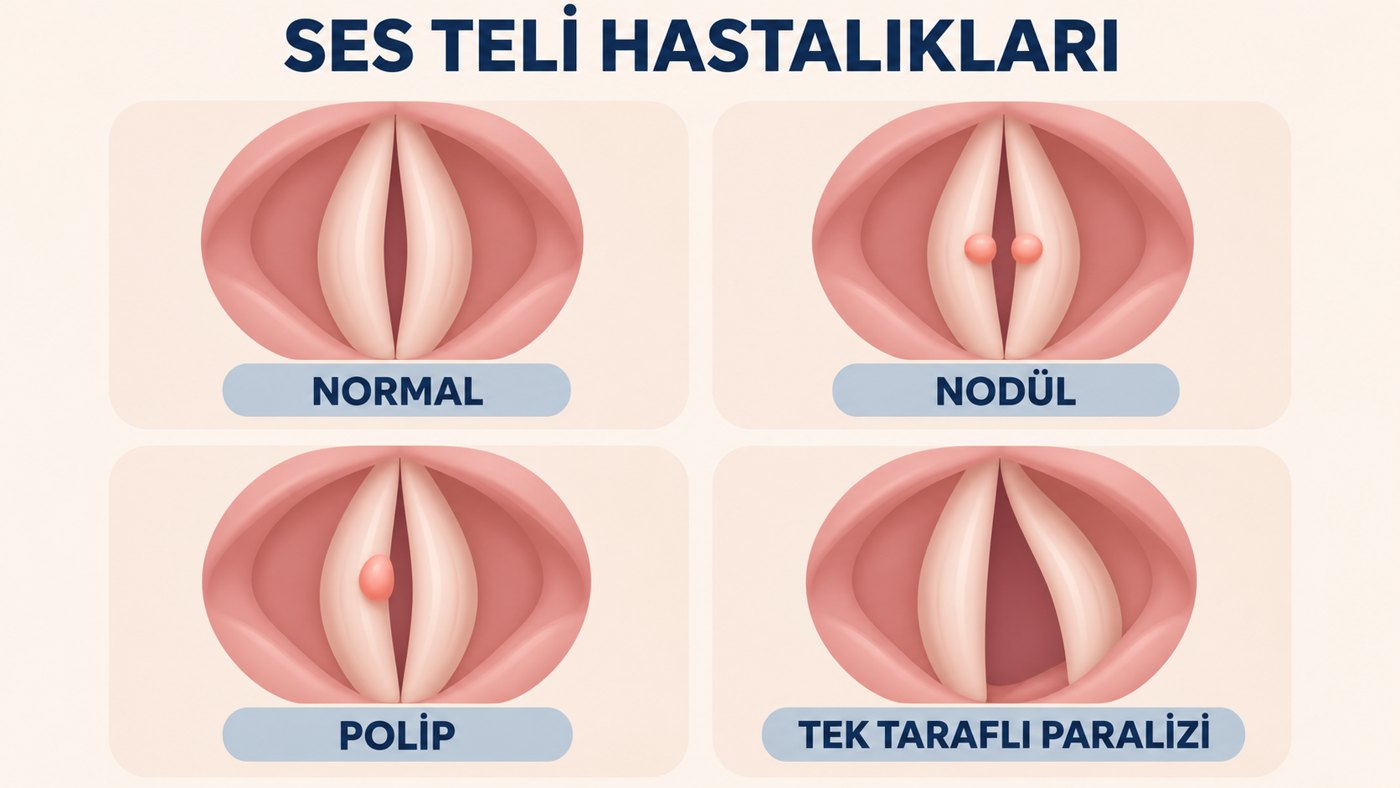
How is the voice produced?
The voice is produced when the two vocal folds inside the larynx (voice box) vibrate as air from the lungs passes between them. On breathing in, the vocal folds move apart to open the airway; on speaking, they come together and vibrate. They also close during swallowing to stop food and drink entering the windpipe. Anything that disturbs the structure or movement of the vocal folds can cause hoarseness.
The main causes of hoarseness
- Acute laryngitis: Inflammation of the vocal folds that accompanies upper respiratory tract infections and usually clears up by itself within a week or two.
- Lesions caused by misuse or overuse of the voice: Vocal fold nodules, polyps and cysts. They are common in teachers, singers and others who use their voice heavily.
- Reflux: Stomach contents reaching the throat can irritate the vocal folds.
- Vocal fold paralysis: The nerve that moves the vocal fold is not working.
- Laryngeal cancer: An important cause of persistent hoarseness, especially in smokers.
If hoarseness lasts more than two to three weeks, see an ENT specialist. The vocal folds can be examined painlessly in the clinic with an endoscope in a few minutes; where needed, their vibration is assessed in detail under a special light (stroboscopy).
What is vocal fold paralysis?
Vocal fold paralysis means that a vocal fold cannot move because the nerve that moves it (the recurrent laryngeal nerve) is damaged or not working. It may affect one side or both. The symptoms and treatment of the two are very different.
What causes it?
- Thyroid and parathyroid surgery, other neck surgery, heart and chest surgery
- Tumours in the neck, chest or skull base pressing on or invading the nerve
- The breathing tube placed during general anaesthesia
- Viral infections
- Stroke and other neurological diseases
- Injuries to the neck and chest
In some patients no cause is found despite thorough investigation.
Paralysis on one side
When one vocal fold does not move, the two folds cannot close fully. As a result:
- The voice is hoarse, breathy and weak; it is hard to raise the voice.
- Speaking is tiring and the patient runs out of breath.
- There may be coughing and choking, especially when drinking liquids (liquid entering the windpipe).
Breathing is usually unaffected.
Paralysis on both sides
When neither vocal fold moves, the folds usually lie close together near the midline. The voice often remains good; the main problem is narrowing of the airway:
- Shortness of breath that is worse on exertion
- A noisy, whistling sound on breathing in
- In severe cases, difficulty breathing even at rest
This picture is sometimes mistaken for asthma. Because it affects the airway, bilateral vocal fold paralysis is a serious condition that needs close follow-up.
How is it diagnosed?
The diagnosis is made by examining the vocal folds with an endoscope and assessing their movement. If there is no obvious cause (such as recent surgery), imaging (CT or MRI) is performed along the course of the nerve, from the brain to the chest. In some patients the electrical activity of the laryngeal muscles is measured (laryngeal EMG) to help predict whether the nerve is likely to recover.
Treatment of paralysis on one side
If the nerve has not been divided, the paralysis may recover by itself in the first months. Treatment is therefore planned according to the severity of symptoms and the time since the paralysis began:
- Voice therapy: Exercises guided by a speech and language therapist strengthen the voice and make swallowing easier.
- Vocal fold injection (injection laryngoplasty): A filler is injected into the paralysed vocal fold to bring it towards the midline. Materials with a temporary effect can be used early on, while waiting for the nerve to recover.
- Thyroplasty (medialisation): In permanent paralysis, a small operation through the neck moves the vocal fold permanently towards the midline.
Treatment of paralysis on both sides
The priority is to secure the airway. In severe breathlessness a temporary or permanent opening in the windpipe (tracheotomy) may be needed. The method most often used to widen the airway is to open the back part of one vocal fold with a laser through the mouth (posterior cordotomy or arytenoidectomy). These operations strike a balance between breathing on the one hand and voice and swallowing on the other: as the airway widens, the voice may weaken somewhat. In suitable patients they can avoid the need for a tracheotomy, or allow an existing tracheotomy to be closed.
Restoring the airway in bilateral vocal fold paralysis, and studying airflow with computer models, are among the clinical and research interests of Prof. M. Kürşat Gökcan.
Looking after your voice
- Drink plenty of water; avoid smoking and tobacco smoke.
- Avoid shouting, and speaking loudly or in a whisper for long periods.
- Avoid clearing your throat frequently.
- If you use your voice heavily, take voice breaks during the day.
- See a doctor if hoarseness lasts more than two to three weeks.
Sources
- Stachler RJ, Francis DO, Schwartz SR, et al. Clinical Practice Guideline: Hoarseness (Dysphonia) (Update). Otolaryngology–Head and Neck Surgery 2018.
- Merck Manual Professional Version. Vocal Fold Paralysis.
- Gökcan MK, et al. A computational study on the characteristics of airflow in bilateral abductor vocal fold immobility. Laryngoscope 2010.